Monday, November 9, 2009

"Bible Lore"

A few of my recent posts have reminded me of yet another subject.

A classic pet peeve of mine is the enormous amount of "Bible Lore" out there. How many times have you been talking with someone and they say, "Well, the Bible says, 'God helps those who help themselves.'"?  No, the Bible does not say that phrase anywhere. It actually came from Ben Franklin.

Another great one..."God won't give you more than you can handle."  The Bible actually doesn't say this.  (Try "quoting" such a "scripture" to a person in a serious crisis.  Let me know how that one goes.)  You won't find the reference because it's not there.

In general, I simply hear the words come from someone's mouth: "Doesn't it say in the Bible somewhere...." or "What's the verse in the Bible that says something about..." and I begin to brace myself for the shock. I never know what nonsense might sputter out after the first few words. :)

The Bible (and spiritual things in general) is one of those subjects that everyone has an opinion about....many people are eager to share their own.  Many people think they know fairly well what the Bible says, but in reality haven't studied it for themselves a whole lot.  In short, "Bible Lore" results is a lot of muddled thinking about spirituality and numerous common myths about Christianity, Christians, God, the Bible, etc.  

So, here's a novel thought: how about we all make it a goal of ours to READ our Bibles and MEMORIZE scripture? That way, instead of being guilty of such embarrassing blunders of biblical illiteracy, we can know God's word, hide it deep within our hearts, and be ready to explain the scriptures the next time someone rattles off one of these statements. 

I myself am by no means immune or beyond this fault.  I have been praying and asking God to reveal some things to me lately and yet I know that the easiest way to hear God's voice is to open and "devour" my Bible. How about you?  Are you planting scripture within you?  Or is your Bible just a dusty relic?   When was the last time you cracked it open? 

-RCW

Monday, November 2, 2009

Search the Scriptures

I was a substitute teacher about a week ago. Not for a school. For an Adult Bible Fellowship (ABF) at the church in which I serve. I was assigned the topic of Christology. While I wouldn't call myself a theologian, I could manage to go over some notes from Hodge's, Erickson's, McGrath's or Grudem's works and some of my own systematic theology notes from back in the day. Yet, I had no idea what a joyful surprise it would be to teach this particular class.

The class was very talkative and very inquisitive. The group was made up of mostly thirty-somethings and from what I could tell on the surface, they didn't have a ton of Biblical literacy.

Perhaps the most encouraging thing about this group was their eager desire to know about the Bible. They had a thirst for knowledge, a hunger to understand, a tenacity to learn. This is perhaps the most foundational characteristic of a disciple.

I was reminded of the Bereans...The Bereans are mentioned in Acts 17:11 -- "Now these [the Bereans] were more noble-minded than those in Thessalonica, for they received the word with great eagerness, examining the Scriptures daily to see whether these things were so." (NASB)

May we all be sure to live with that same hunger to know. Search the Scriptures for yourselves and see if these things are not so.

Prayer: Father, help me to cultivate a passion for Your word. Help me to develop a hunger within me to understand the Bible and apply it to my life. Let it always be said of me as well that I was noble-minded and diligent in searching the Scriptures. Amen.

-RCW


P.S. The title for this blog entry ("Search the Scriptures") also happens to be the name of a couple of ministries, a devotional book, a .com website, a couple of .org websites, etc. In no way am I claiming to own the title or have rights to it, in no way am I endorsing those sites, books, ministries, etc.

Saturday, October 10, 2009

Faith "Firmly Rooted"???

What's with the title, huh?


I guess I have never quite explained how I selected the title for this blog exactly, have I? The concept of being "rooted" or "planted" or "having roots" are all pretty common in Biblical imagery. Certain passages should hopefully leap to your mind.

Psalm 1 may very well be my own personal favorite. Below is Psalm 1:1-4 :

    How blessed is the man who does not walk in the counsel of the wicked, Nor stand in the path of sinners,
    Nor sit in the seat of scoffers!

    But his delight is in the law of the LORD,
    And in His law he meditates day and night.

    He will be like a tree firmly planted by streams of water,
    Which yields its fruit in its season
    And its leaf does not wither;
    And in whatever he does, he prospers.

    The wicked are not so,
    But they are like chaff which the wind drives away.


Another example that will probably come to mind comes from Paul's prayer for the Ephesian believers in Ephesians 3:14-19

    For this reason I bow my knees before the Father, from whom every family in heaven and on earth derives its name, that He would grant you, according to the riches of His glory, to be strengthened with power through His Spirit in the inner man, so that Christ may dwell in your hearts through faith; and that you, being rooted and grounded in love, may be able to comprehend with all the saints what is the breadth and length and height and depth, and to know the love of Christ which surpasses knowledge, that you may be filled up to all the fullness of God.


Another passage from Paul that comes to mind is Colossians 2:5-7, where Paul urges the Colossians:

    For even though I am absent in body, nevertheless I am with you in spirit, rejoicing to see your good discipline and the stability of your faith in Christ.
    Therefore as you have received Christ Jesus the Lord, so walk in Him, having been firmly rooted and now being built up in Him and established in your faith, just as you were instructed, and overflowing with gratitude.


Finally, there is the parable from Jesus about the sower and the soils in Matthew 13. Jesus explains the parable of the sower for his disciples in Mt. 13:19-23:

    When anyone hears the word of the kingdom and does not understand it, the evil one comes and snatches away what has been sown in his heart. This is the one on whom the seed was sown beside the road.

    The one on whom the seed was sown on the rocky places, this is the man who hears the word and immediately receives it with joy; yet he has no firm root in himself, but is only temporary, and when affliction or persecution arises because of the word, immediately he falls away.....

    And the one on whom seed was sown among the thorns, this is the man who hears the word, and the worry of the world and the deceitfulness of wealth choke the word, and it becomes unfruitful.

    And the one on whom seed was sown on the good soil, this is the man who hears the word and understands it; who indeed bears fruit and brings forth, some a hundredfold, some sixty, and some thirty.


So how about it? Are you rooted in Christ? Are you un-budged by the sways of this world? Are your feet planted in the good soil? Are you anchored to the word of God? Are you hearing the word AND doing it? If not, it's time to get YOUR faith firmly rooted.


Prayer: Dear Lord Jesus, I pray that you would ground me even now in your word. I repent for times I have strayed from obeying you and seeking you. I pray that there would be no room for wavering or falling away from what you have taught me. May you keep my feet planted and my faith on solid ground. Help me remain in you, Jesus. Amen.


-RCW

Tuesday, September 29, 2009

On Protestant Denominations

Evidently, my last post was a very relevant issue for some people. It has elicited the need for another post on denominations.

For now, an introductory read can be found by my friend Matt Slick of www.carm.org. Just click here to read it.

I also mentioned the Rose Publishing pamphlets. Click here to see a great one on denominations, here to see one on Christianity, cults, and world religions, and here to see one on Christianity, cults, and the occult. They also have one on Mormons and Jehovah's Witnesses if you were intrigued by some of those comments. Another great denomination comparison is available here through Ron Rhodes, a man who has published a ton of resources on world religions, cults, and Christianity, etc.

These pamphlets are good starting points. Starting points simply give user-friendly information without a ton of academic discussion. For a somewhat deeper and more researched resource, people could purchase one of H. Wayne House's charts that can be found by clicking here.


Hope this is helpful for now.

Choosing a church is an important decision for any believer. Most new believers choose to attend the church where they became a Christian, the church that they know best or the church of one of their closest Christian friends (perhaps the church of a person who was instrumental in their decision to embrace Christ).

These resources can help make sense out of the host of churches out there....what they have in common and what is markedly different (in theology and practice) about each one. I will likely publish one or two more little tidbits on this subject of denominations.


-RCW

Thursday, September 24, 2009

Roadmaps of Religious Belief

There's a lot of confusion out there among the masses when it comes to "religion" and spiritual matters.

  • Example #1:
    Suppose I tell someone out in public that I am a minister. Often, they will ask, "Oh yeah, what religion are you?" I tell them "Christian" and they will say, but what religion are you...Methodist, Lutheran, Baptist?"

    If you can't spot the misunderstanding here, then I will explain it momentarily.


  • Example #2:
    I was at a college campus sharing my faith with students a few years ago and within a 10 minute period, I asked two separate people if they were Christians. The one replied, "Yes, I'm Catholic." The other replied, "No, I'm not a Christian. I'm Catholic."

    Puzzling, huh?


  • Example #3 comes when people recite the Apostle's Creed:
    I believe in the Holy Ghost;
    the holy catholic church...
    the communion of saints;
    the forgiveness of sins;
    the resurrection of the body;
    and the life everlasting.

    A certain church I enjoyed in graduate school (it was not a Catholic church) used to recite the creed every single Sunday. I don't know how many times I heard people either refuse to speak the line or say afterward, "I don't like that line about the Catholic church."

    Are you tracking with me?


  • Example #4: Jehovah's Witnesses and Mormons will often insist that they are Christians. And some people actually believe them!


This is not a rant against those that make such statements or betray such obvious misconceptions. Instead, I hope that it will clear up some of the misunderstandings.

I think some simple charts can do the job.

Below are some examples of world religions.


A religion is a comprehensive belief system held by a community. It usually has a "holy book" and typically provides answers 3 questions: What is reality? What is wrong? What is the solution? If you see a flaw or simply don't like my off-the-cuff definition, here's a link to Wikipedia's definition of a "religion." Notice that Christianity is a religion.


The next chart is the three major "branches" or "realms" of Christianity. (I'm sure there is a better word, but for now right now the most commonly used term escapes me.) These are not different religions; they are actually all considered part of Christianity.


Finally, after the Protestant Reformation (notice the spur of Protestantism off of Catholicism in the chart above), a virtual plethora of Protestant "denominations" arose. Below is a chart of some of the ones you might be familiar with. (Ironically enough, the earliest of these various denominations proceeded to fight and kill one another quite frequently for several years. Aren't you glad that we now fortunately realize that we who are Protestants are all Christians and that Lutherans need not slay Baptists, Anglicans shouldn't behead Lutherans, etc.)


Don't study the above chart too closely. The denominations aren't arranged in any particular fashion except that "lots of others" can be a sub-category of "Bible Churches" or "Non-Denominational" or entirely outside of both categories. One of the problems however is that many non-Christian religious movements, groups, and cults, aim to convince people they are a "denomination" when in actuality, the beliefs make them otherly altogether (a different religion).

My charts are very simplistic. Better charts are published in pamphlet form by Rose Publishing.


Does this clear up some of the confusion? If you're still wondering about the earlier examples, here are the answers, you sillies:

    Example #1 - My religion IS Christianity. What they should have asked was what denomination I am.

    Example #2 - The truth is that Catholics ARE under the umbrella of Christianity. Some Catholics might think that when they are asked if they are a "Christian," the question is asking if they are a Protestant or someone associated with "mainstream" Protestant Christianity.

    Example #3 - Even though the term "Catholic" probably would have originally referred to the Catholic church (since the Catholic church WAS the early church), the term "catholic" as we know it today refers to the universal church. The "catholic" church would then simply mean those around the world from every Christian group or denomination calling themselves followers of Christ. (See how the "church" is also not just a building? It's PEOPLE. WE are the church.)

    Example #4 - Jehovah's Witnesses & Mormons commonly claim they are a Christian group or a Protestant denomination. (They try to convince people that they belong in the "lots of others" category in the list of denominations under "Protestantism.") Yet, if you study those groups, the beliefs CANNOT fall under the umbrella of Christianity since the views they hold have been deemed UN-Christian by Jesus, by the church from earliest Christianity, and sometimes even earlier...by Judaism. There is no way that the two groups could ever call themselves Christians except to mislead and sway others, or to simply distort the ugly truth.


Well, enough of my rambling. I hope that this proves helpful the next time you spot a similar misconception. Point your guilty violators to this post and maybe it can clear up the confusion! :)


-RCW

Monday, August 31, 2009

Q & A Resources

Okay, so one of the best things we do in the Bible Study that I help lead is a Question & Answer session. Members are encouraged to bring a friend, bring some food, and bring a question that can be about the Bible, about Christianity, the Christian life, a certain Bible passage, theology, the church, etc.

A couple of the times we did the Q & A session, I mentioned a few resources that someone might be able to consult if they wanted to "cut the middle man out" so to speak. In other words, if someone wanted to play the Question and Answer game on their own, they could consult these resources (among others). Here those are resources as well.


R.C. Sproul - Now That's A Good Question


Ravi Zacharias - Who Made God? and Questions to Over 100 Other Tough Questions of Faith


Paul Little - Know Why You Believe


CARM -
This is a wonderful resource that I stumbled onto as a senior in high school. Christian Apologetics Resource Ministry is a tremendous wealth of information on virtually any topic that you could ever confront. World religions, difficult passages, theological questions, etc. I am not saying that I agree with everything you will find there, but you will find that it is extremely helpful. It attempts to be objective and answer questions in ways that are Biblically faithful and theologically sound. Check it out for yourself!


The Theology Program - If you have questions that are of a more theological nature, a great resource is the Theology Program's resources.


Remember, these are just a few user-friendly resources for starters. There are certainly other great ones as well.


-RCW

Friday, August 21, 2009

A Few Spiritual Growth Resources (Part 4 of 4)

Five Things Every Christian Needs to Grow -
This brief and user-friendly resource is an excellent guide for new Christians desiring to begin growing in their walk with Christ or for stagnant Christians that might suddenly realize they're not growing in their walk with Christ. I have already mentioned in a previous post of my admiration of R.C. Sproul. In this short book, Sproul identifies five crucial “nutrients” that promote spiritual growth: Bible study, prayer, worship, service, and stewardship.


Celebration of Discipline: The Path to Spiritual Growth -
I don't know how to summarize this book adequately in a few sentences. It has won countless awards, it is used all over the world in theological schools and seminaries, and it is perhaps the best book on the spiritual disciplines out there. I can put it to you this way: Nearly everyone who attended seminary in the last 25 years has probably read or at least purchased this book. Richard Foster, the books author, comes from a Quaker background, but you certainly don't have to agree with every little statement or opinion of his to get enormous insight from this book.


The Imitation of Christ -
Written over five centuries ago by Thomas à Kempis, The Imitation of Christ has been translated into more languages than any other book except the Bible (according to the back cover of my copy). It has been acclaimed by countless readers as one of the greatest spiritual masterpieces ever written. John Wesley considered The Imitation of Christ to be of such value to spiritual growth, and the best summary of the Christian life, that he personally translated it for the use of his followers. This book was instrumental in the early Methodists' revival of England. There's a reason this book has stood the test of time...it's certainly a Christian classic.


A Year With C.S. Lewis -
Beloved author C. S. Lewis is our trusted guide in this intimate day-by-day one year companion offering his distinctive and celebrated wisdom. Amidst the bustle of our daily experience, Lewis writes about themes such as the nature of love, the existence of miracles, overcoming a devastating loss, and discovering a profound faith. These daily meditations have been selected an put together from Lewis's celebrated classics: Mere Christianity, The Screwtape Letters, The Great Divorce, The Problem of Pain, Miracles, and A Grief Observed, as well as from the distinguished works The Weight of Glory and The Abolition of Man. Throughout the book, the reader will also find biographical commentary about C. S. Lewis's life. A perfect resource for everyone who cherishes Lewis's timeless words.


A Year With Dietrich Bonhoeffer -
Dietrich Bonhoeffer was only thirty-nine when he was executed by the Nazis in 1945, yet his influence on Christian life has been enormous. His passionate, theology-based opposition to Hitler's Nazi regime made him a leader, along with Karl Barth, in Germany's Confessing Church. Bonhoeffer is embraced by both liberal and conservative Christians, and the integrity of his faith and life have led believers everywhere to recognize him as one of the greatest theologians and philosophers of the twentieth century. This book showcases his letters, sermons, and writings--which are a treasure of spiritual wisdom, social conscience, pastoral care, and theological insight--in a one year daily devotional format. This resource is sure to encourage and deepen your reflections and meditations. There's even a foreword by Jim Wallis, author of God's Politics. Bonhoeffer's faith led him to lay his very life down and his influence will forever continue. (As an aside: Other titles by Bonhoeffer that would be good to read and grow in Christ include The Cost of Discipleship and Life Together).


Christian Beliefs : Twenty Basics Every Christian Should Know -
Theology is important because what we believe affects how we live. Wayne Grudem's beefy textbook Systematic Theology has established itself as a foundational reference in the evangelical church today, prized by pastors and teachers everywhere. But this is not that book. Instead, this is a very readable condensation of Grudem's award-winning book on systematic theology. It is a reader-friendly guide to Christian doctrines--for new believers and all Christians. If you're a relatively new believer in Jesus, or if you're a more mature Christian looking for a quick brush up on basics of the faith, Christian Beliefs is a great resource.


Spiritual Disciplines for the Christian Life -
The message of this book is that: Far from being legalistic, restrictive, or binding, as they are often perceived, the spiritual disciplines are actually the means to unparalleled spiritual liberty. So if you'd like to embark on a lifelong quest for godliness, Spiritual Disciplines for the Christian Life will help you on your way. Based on the rich heritage left us by the early church fathers, the Puritan writers, and Jesus Christ Himself, Whitney takes you through a carefully selected array of disciplines that includes Scripture reading, prayer, worship, Scripture meditation, evangelism, serving, stewardship, Scripture application, fasting, silence and solitude, journaling, and learning. By illustrating why the disciplines are important, showing how each one will help you grow in godliness, and offering practical suggestions for cultivating them on a long-term basis, this resource will provide you with a refreshing opportunity to embrace life's greatest pursuit--the pursuit of holiness--through a lifelong delight in the disciplines. Whitney currently teaches at Southern Baptist Theological Seminary in Louisville. This is also the book that probably most closely approximates Celebration of Discipline.


Ten Questions to Diagnose Your Spiritual Health - The title of this books pretty well describes it. Whitney poses intensely introspective questions to aid Christians as they gauge their own level of spiritual health. Do they have a driving thirst for God, as well as behavior dictated by God's holy standards? How loving to others and sensitive to the Holy Spirit are they? Do they experience genuine grief over personal sin and a willingness to forgive repeat offenders? Whitney also discusses the spiritual disciplines of prayer, fasting, meditating upon Scripture, and so forth, showing readers how to transform these often routine rituals into faith-building activities. He advises Christians to spend more energy enjoying God and developing a Christlike nature and makes readers aware that following Christ is a lifetime commitment. This book is great for unearthing deeply entrenched habits and digging for the treasure found only in a carefully-kept relationship with God.


Alright, so that concludes this series of posts about spiritual growth resources, but I am sure you are well aware that not just more resources out there, but that this won't be the last time I provide lists of resources. :)


-RCW


By the way, I apologize if some of these descriptions read a bit like a sales pitch. That is because I used portions of the books' own descriptions to formulate my own, tweaking things here or there. It's not plagiarism because 1) I am telling you what I did; 2)Who is going to argue that the books are REALLY about what I have said. If anything I have tried to be more faithful to the books themselves by using their own descriptions; and 3) What writer or publisher would have a problem with me showcasing their books and suggesting them as resources?

Tuesday, August 11, 2009

"The Question"

I experience so many blessings working for the church and doing the things that God has called me to do in that setting...specifically, my role at the church is to help adults (everyone from college age upwards) to grow in their faith.

So, naturally I feel that I have an amazing job that is certainly full of its own rewards. But today I had a special blessing. An individual I just met on Sunday for the first time called me up on the phone and asked me one of the questions that I am convinced pleases God so tremendously. He simply asked, "What can I do to become a stronger Christian? How can I grow in my faith?"

Have you asked that question lately?

-RCW

P.S. (Answering that very question is part of this blog's purpose!)

Thursday, August 6, 2009

A Few Spiritual Growth Resources (#3 of 4)

Knowing God Through the Year with J.I. Packer -
Every Christian should read J.I. Packer's Knowing God. It is a classic that will surely endure the test of time...not to mention it's written by one of the most outstanding churchmen and theologians alive today...Did I mention he attended C.S. Lewis's lectures while a student at Oxford and later as a result gave his life to Christian ministry? Anyway, enough about the author (can you tell he's a hero of mine?). About the book: this is a one-year guide through one of the most treasured books of Christian spirituality: J. I. Packer's Knowing God. Each day you'll read a Scripture and a brief passage about the glory of God and the joy of being in relationship with Him. An idea at the end of each day's reading will help you to respond to God in prayer and reflection.


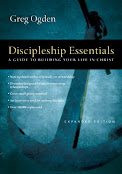
Discipleship Essentials -
This resource can be used in a variety of ways. Even though this material is designed for groups of three, it can also be used successfully as an individual study, a one-on-one discipling tool or even a small group curriculum.
Each week contains the following elements:
-a core truth presented in a question-answer format
-a memory verse and accompanying study
-an inductive Bible study
-a reading on the theme for the week
-questions to draw out key principles in the reading


Morning and Evening -
Charles Spurgeon’s Morning and Evening has earned its status as a devotional classic. Generations after Spurgeon's death, Christians are still finding his timeless and original engagement with God's Word to be a refreshing way to begin and end their day. In this yearly devotional, there is literally a very short devotional for the morning and a very short devotional for the evening for every single day. Spurgeon was one of the most noteworthy Baptists in history. If that weren't enough, this particular edition has the touch of one of my favorite pastors alive today as well...Noted pastor and author Alistair Begg has updated Spurgeon's language while preserving the dignity and clarity of Spurgeon's original words and written a nice introduction as well.


Learning from Jesus (a Renovare' Spiritual Formation Guide) -
These guides are workbooks that personally take you on a journey to be more like Christ. The aim of this one is to make you more like Christ by doing a focused study on Jesus Himself. It covers everything from Jesus's interactions with those around him to His revolutionary wisdom recorded in the Gospels. Other titles in the series include "Connecting with God", "Living the Mission", and "Prayer and Worship". The Renovare' website is a great place to find other resources as well. These guides can be used by individuals as well as small groups.


Everyday Blessings with Max Lucado -
If you love Max Lucado's books, you will be delighted to find this resource. This is a small devotional with very short entries for every day of the year that come straight from the pen of the beloved Christian inspirational author. 365 reflections on individual scriptures in a conversational style that people everywhere have come to love.


The Keys to Spiritual Growth -
I own this but haven't really read it entirely, so here's a "canned" description: God intends for every Christian to grow to spiritual maturity. His Word commands us to progress daily toward a fuller personal knowledge of God and Christ. In this book Pastor John MacArthur thoroughly explores a multitude of biblical passages to reveal the riches of God in Jesus Christ--riches that will help us continue growing in both faith and spirit. This noted pastor and author takes readers back to the basics of what the true Christian life is all about, so that they can unlock the treasures God has for them in Christ. Sorry to use the lame "infomercial" language to describe it. John MacArthur is certainly a beloved, well-known, competent author when it comes to spiritual growth, understanding the Bible and theology, etc.


Running the Race: A Graduate’s Guide to Life -
If there's one resource I like to put into the hands of recent high school or college graduates, it is this one. Graduates have many important decisions to make-about careers, education, dating, and marriage-all of which will be influenced by their faith. Sproul invites graduates to think about what they believe and how their worldview and the worldview of others will touch each aspect of their future. Along the way, he offers helpful tips on how graduates can discover God's will and bring their life into harmony with it. Drawing from some of his classic books, Sproul even gives a brief overview of philosophies that graduates may encounter as they meet people who approach the world differently. Sproul also answers common questions graduates ask about their faith, including: "Why should I trust the Bible?" "Isn't it narrow-minded to say Christ is the only way?" and "Why does God let horrible things happen?" Sproul is founder and chairman of Ligonier Ministries, is a professor of systematic theology and apologetics at Knox Theological Seminary, speaks on the daily radio program "Renewing Your Mind", and has written or edited more than fifty books. (Did I mention he's one of my personal heroes?)


Hope these are still proving helpful!


-RCW

Saturday, August 1, 2009

Self Examination

Going just by the title, let me answer what may be a question for some of you...No, this posting is not about breast exams, physicals, prostate or testicular cancer. In other words, it is safe and pleasant to keep reading. :)

SOME PHILOSOPHICAL TIDBITS
I posted a few weeks ago about our natural and dangerous tendency as humans to fault-find and judge others. Later this week I received a fortune cookie with a message that I thought naturally tied into this post. It simply reads: "It is more difficult to judge oneself than to judge others." I read it and thought, "Perhaps that's why we don't do it (judge ourselves)."

We can switch though-patterns too...The Chinese wisdom in fortune cookies reflects tidbits of what you might call "eastern philosophy." What about what is commonly known as "western philosophy?"

Even Socrates -- the great philosopher and teacher of Plato -- is attributed to have employed the maxim, "The unexamined life is not worth living." That's not just some archaic quip. In essence, the statement asserts that someone who gives no thought to how they live, what they do, what they say, and never taking time to do some introspection or reflect on their own priorities (90% of Americans) are living a meaningless existence.

THE CONCLUSION
Okay, so you don't have to be a follower of Jesus to do what Plato and my silly little fortune cookie suggest. The philosophers seem to understand its importance well enough. You can examine yourself just fine regardless of your faith perspective. But where the process differs for the Christian is in the standard by which we measure ourselves. For the Christian, we should obviously look to the Bible for our spiritual idea of what should be normal in our lives. More specifically, we long to be more like Christ and develop the fruit of the spirit, grow in godliness, etc. Someone outside the fold of the Christian faith is left to merely aim for "a better self" or readjusting their priorities in such a way that they are more likely to bring success or happiness, etc.

God expects perfection from us. He says multiple times throughout the scriptures, "Be holy as I am holy." The only way to attain it? -It's embracing the work of Jesus Christ and asking that the sacrifice He made on the cross to count for you. If your reading this blog, you probably already know that. But think for a moment just how revolutionary this is for us who have Jesus - we don't have to worry about a thousand priorities or "try" to be better. We don't have to settle for a vague definition of what is best. We don't have to go it alone and figure out what works best for ourselves.

No, instead we have it all there before us. Jesus Christ and His righteousness have become ours. When we do our self-examining we are doing more than looking at ourselves. We are asking God to look at us. We are submitting to His words about what is best for us. We are asking Him to let us see ourselves as He sees us.

What I am speaking of is a spiritual self-examination. Is it time for one?


THE RESOLUTION
Prayer: Lord, help me to make your word the standard by which I measure my success. Help me to examine my own spirituality and determine if it reflects more of you or if it simply reflects more of me. God help me to set aside all worrying and prioritizing that does not have you at the center of the picture. Send me to your word to find my answers for how I should be living, how I should spend my time, what I should say, what I should do, where I should go, how I should act, and ultimately the goal for which I strive. Conform me more
-- even this very moment -- into the image of You. Amen.

Wednesday, July 29, 2009

More Spiritual Growth Resources (Pt. 2 of 4)

RZIM Critical Questions Series (Titles Include: Can I Trust the Bible?, What is Truth?, Who Was Jesus?, Is God Real?) -
Some of the world's leading Christian intellectuals have put together a set of Bible study guides that address the deeper questions that skeptics and thinkers often have that keep them from Christianity. Honest answers to tough questions. If Ravi Zacharias has his initials on it, you know it is going to be intellectually up-to-snuff.


From Creation to the Cross -
Since this book is basically an introduction to the Old Testament with questions for personal reflection following each chapter, it may be best-suited for those who are ready to ride without the training wheels. Most Christians don't quite know what to do with the first half of the Bible. From Creation to the Cross is a guide through the Old Testament that points out along the way perspectives and insights that leave us with a new, personal understanding of these thirty-nine books that ultimately point us to Jesus.


Your Life in Christ (Book 1 in Navpress' “Design For Discipleship” Series) -
If you are looking for something basic and user-friendly, yet but Biblical, deep, and profound, this is the study to start with. This is one of the books I put in the hands of new believers who are looking to start growing in their faith. It is published by one of my favorite publishers, NAVPRESS - a large Christian publishing company that publishes nothing but books and resources meant for Christian discipleship. (What an amazing ministry, eh?) This is the just the first book of the series.


New Life in Christ -
This is the other resource that I like to sometimes put into new believers' hands. It is again very basic and user-friendly, but in the end deeply Biblical. The back cover reads: "It starts with a tiny seed of faith that takes root in your heart. Then, like a tree, it grows into something strong, beautiful, and living whose influence dominates the landscape of your life. This is the nature of life in Christ—something so profound that the Bible says you are literally a new creation. Your new life in Christ is much more than what you experienced at conversion. God wants to open your eyes to all the marvelous things he has given you as his child. This study guide will help you grasp the hope, the riches, and the great power God has given you through his Son, Jesus."


My Utmost For His Highest -
A world of things could be boasted about this book. It is probably the best-selling devotional of all time, and probably one of the best-selling Christian books of all time (second maybe to John Bunyan's Pilgrim's Progress). Whatever the statistics, it is a classic for a reason. With humor and humility, Chambers speaks plainly to the common man struggling with devotion to Christ in daily living. Worldly cares and self-serving desires begin to lose their appeal as Chambers aides the reader in transforming his mind by viewing life through the instruction of God's Word. Each daily reading is a short encouragement or reflection based upon a certain given text of scripture.


Yahweh: Divine Encounters in the O.T. -
This is a workbook that takes you through the Old Testament in 48 weeks. Each lesson has scripture and interactive questions that will help you apply God's word into your own life. This is a great place to start if the Old Testament intimidates you or if you really struggle with drawing out meaningful quiet time reflections from the Old Testament. (Plus, one of my supervisors Ty Gulick was the executive editor for the book). :)


How to Read the Bible Book by Book -
Have you ever been totally clueless about what the scriptures are talking about as you read in your quiet time? This is a wonderful guide that anyone might consult to help them work through any book of the Bible or the entire thing. Every book of the Bible gets about a 3 page treatment...Tips for Reading, What to Watch For, An Outline of the Book, Key Themes, etc. This is one of the best references you can use to REALLY understand what the book meant before you begin to decide and apply what it means for your life.


Stay tuned for the rest...And happy reading!

-RCW

Thursday, July 23, 2009

A Few Spiritual Growth Resources (Part 1 of 4)

Recently I was teaching our college and young adults at church and we were studying the topic of spiritual growth...especially regarding quiet times and spiritual growth resources. I did something unique in that I had them each draw a number and the number they drew was keyed to a spiritual growth resource I had brought along to the class. They each grabbed their resource and I gave them approximately 5 minutes to look it over long enough to tell the entire class about the resource, its value, etc. Some people have asked me to go ahead and list those resources I brought with me that day. Here they are in a four-part installment.

Also, these make great Christmas gifts since many of them are "Through the Year Devotionals" and Christians young and old might be making New Year's Resolutions.

Remember these are just a few resources (the possibilities are endless, so this list is by no means exhaustive) that someone could use during his or her devotional time. Also, let me say that while these resources may be helpful in cultivating a devotional life, there's still no substitute however for simply going straight to your Bible during your devotional time.

So here you go....the first of four posts of spiritual growth resources.


The One Year Book of Christian History -
This resource has a one page devotional for every day of the year. On each day of the year, you'll read a stirring story about a character or event in church history. It is particularly interesting because in each devotional, the dates of the devotionals correspond to the dates in the story. In other words, each day you'll read about something in church history that occurred ON THAT VERY DATE.


A Faith and Culture Devotional -
This resource is amazing because it is a sort of "Christian Worldview" devotional. The devotionals come from Christian academics from a wide array of fields...art, history, science, bible and theology, philosophy, economics, etc. This makes a great devotional for the Christian who enjoys using their mind and who realizes the very important reality: that all of our life belongs to God and relates to Him rather than just the church time, devotional time, prayer time, etc. Truth and Beauty...wherever they can be found (in science, in sociology, in literature, etc.) belong to God and have their source, origin, root, their context, and their truest meaning when they are seen in reference to Him.


Through the Bible Through the Year -
This daily devotional offers reflections on passages from Genesis though Revelation. The author (John Stott) is one of the most internationally acclaimed Christian pastors and scholars. The great thing about this devotional is that it takes you through the entire Bible and help you connect both the details of the events with the broader story as a whole. You get the Bible's "big picture" and larger theological concepts and themes WHILE you go through each individual book. A gem if I might say so myself.


Letters Along the Way -
Some say this book is "like Screwtape Letters in reverse". Imagine that you had a sort of older and wiser Christian who had a wealth of theological expertise, a wealth of pastoring insight, etc. to walk you through your experiences in the Christian life. All you had to do was write. That's the sort of relationship that sparked this book. The book consists of letters that were sent from a "senior saint" to a 'junior saint"...about all sorts of topics that the Christian might face...conversion, trusting Christ, temptations, the Christian and psychology, sharing one's faith with others, discerning God's will, etc. This is an especially nice read for someone either in ministry or studying for it.


Devotional Classics -
Revised edition of this collection of readings from devotional writers throughout the church ages. This volume includes excerpts from writers such as Augustine, Francis of Assisi, Julian of Norwich, Thomas a Kempis, Martin Luther, John Calvin, Evelyn Underhill, and Dietrich Bonhoeffer. For each reading there are reflections, questions for discussion, and bibliographies for further reading.


Spiritual Classics -
This resource (like the last one) puts together writings from some of the brightest men and women of the Christian tradition. St. Augustine, Thomas Merton, Fredrick Buechner, A.W. Tozer, G.K. Chesterton, Thomas More, Martin Luther King, Jr., Amy Carmichael, Simone Weil, Pierre Teilhard de Chardin, Hildegard of Bingen, John Milton, Dorothy Day, Leo Tolstoy, Gerard Manley Hopkins, and more...From nearly two thousand years of Christian writing comes fifty-two selections complete with a profile of each author, guided meditations for group and individual use, and reflections containing questions and exercises. Editors Richard Foster and Emilie Griffith offer their expertise by selecting inspirational writings and including their own commentary and recommendations for further guided reading and exploration.


Stay tuned for the rest!!!

-RCW