As a minister of discipleship within a local church, I can relate many stories of people finding a Bible Study within our church, plugging in, and beginning to grow deep roots in God's word and in their relationship with Christ.
For others, finding the right Bible study can be a challenge. Here are some things to keep in mind about that.
Ask yourself:
Whose job is it to see that I grow spiritually?
Here are the most common answers to such a question.
1. It is my pastor's job
Yes and no on this one. Your pastor is entrusted with shepherding and spiritual caring for the "flock" that God has placed under his stewardship. However, if all you do is come to church, sing some songs, and listen to a sermon once a week, you might or might not actually ever begin to grow spiritually. Most every pastor (and virtually every pastor worth listening to) would agree that if you really want to start growing spiritually, you'll need to be involving yourself with other believers in Bible study and prayer. Do you know what statistics are showing to be the number one proven way for churchgoers to begin growing spiritually is? It is simply this: Prayerfully study the Bible when you are not at church! Your pastor can't force you to do that, but he can certainly influence and encourage you to do so.
2. It is my church's job (or my discipleship pastor's job)
Yes and no on this one. Your church (and your discipleship pastor if you have one) are like your pastor in that they are entrusted with overseeing and facilitating the spiritual development of those God has placed under their stewardship. However, as much as they labor to assist in people's spiritual growth and make it easy for them, sometimes it doesn't seem to happen. I occasionally receive complaints from people that they are not growing spiritually...some of whom are deeply involved in a Bible study. I know...it is a head scratcher. But even though your church and your ministers strive hard to help you grow spiritually, the job is partly your responsibility as well. Do you show up to church ready to listen and learn? Do you attend a Bible study at your church expecting to hear God speak to you through the scripture? Or are you waiting for just the right Bible study to come along with just the right people with just the right teacher? You might be waiting a long time.
3. It is MY job
This might be getting close to the right answer. It's almost there. As we said before, you should absolutely take responsibilty for your own spiritual growth. Don't let obstacles deter you from it. Your pastor will try to influence and the church should provide avenues for spiritual growth, but nothing is stopping you from picking the Bible up or praying. Every day, spend time in prayer and Bible study. Don't let your spiritual growth rise or fall on a Bible study teacher or whether you can manage to squeeze in time for a small group during the week on top of serving and worshipping. Take ownership of your spiritual development. Make it your priority. Rearrange your schedule and priorities if you must. See if you can let God have your heart every single moment of every single day whether you are at church or not, whether you are reading the Bible or doing anything under the sun! And yet, the responsibility doesn't rest on you alone...
4. It is God's job
Here's a very important truth. God desires that you grow spiritually. And He is orchestrating it behind the scenes in countless ways - through the experiences He allows you, through the relationships you have, through the sermons you hear, prayers you pray, conversations you have, etc. Even when you think you are not growing spiritually, God might strongly disagree. Watch and pray for eyes to see how He is growing you and stretching your faith even in ways you might not see at first glance. Write them down if you need to. The Apostle Paul wrote to the Philippians:
Therefore, my dear friends, as you have always obeyed—not only in my presence, but now much more in my absence—continue to work out your salvation with fear and trembling, for it is God who works in you to will and to act in order to fulfill his good purpose. (Philippians 2:12-13)
Notice that there are two things at "work". We are continuing to work out our salvation with fear and trembling. The idea is that we strive to live in obedience to God and live for Him. But the second "work" is God's work. And it is a different tense. This is a completed work that is already finished. Someone once said, "We are in the process of becoming who God already sees us as." Christ saved us. We are in the process of living like it and in the process of being saved. (The big word for the process is
sanctification...we are in the process of being
sanctified or
made holy or
set apart.) We do our everything to grow spiritually, knowing that it is ultimately God alone who brings it about in our lives, in His own ways and in His own timing and He who started the work in us will be faithful to complete it...and this is so certain that He already HAS completed it!
Whose job is spiritual growth anyway? YES...your pastor and your church play a part. YES...you are accountable for your own spiritual growth. YES and most emphatically...God grants it, He does it, He gets the job done in His people's lives.
-RCW
Bible Reading,
Churches,
Common Misunderstandings,
Discipleship,
Doubt and Struggling,
Encouragement,
Godly Priorities,
Growing,
Just Sayin' / Personal,
Obstacles to Spiritual Growth,
Sanctification
|
Evidently, my last post was a very relevant issue for some people. It has elicited the need for another post on denominations.
For now, an introductory read can be found by my friend Matt Slick of
www.carm.org. Just click
here to read it.
I also mentioned the Rose Publishing pamphlets. Click
here to see a great one on denominations,
here to see one on Christianity, cults, and world religions, and
here to see one on Christianity, cults, and the occult. They also have one on Mormons and Jehovah's Witnesses if you were intrigued by some of those comments. Another great denomination comparison is available
here through Ron Rhodes, a man who has published a ton of resources on world religions, cults, and Christianity, etc.
These pamphlets are good starting points. Starting points simply give user-friendly information without a ton of academic discussion. For a somewhat deeper and more researched resource, people could purchase one of H. Wayne House's charts that can be found by clicking
here.
Hope this is helpful for now.
Choosing a church is an important decision for any believer. Most new believers choose to attend the church where they became a Christian, the church that they know best or the church of one of their closest Christian friends (perhaps the church of a person who was instrumental in their decision to embrace Christ).
These resources can help make sense out of the host of churches out there....what they have in common and what is markedly different (in theology and practice) about each one. I will likely publish one or two more little tidbits on this subject of denominations.
-RCW
There's a lot of confusion out there among the masses when it comes to "religion" and spiritual matters.
- Example #1:
Suppose I tell someone out in public that I am a minister. Often, they will ask, "Oh yeah, what religion are you?" I tell them "Christian" and they will say, but what religion are you...Methodist, Lutheran, Baptist?"
If you can't spot the misunderstanding here, then I will explain it momentarily.
- Example #2:
I was at a college campus sharing my faith with students a few years ago and within a 10 minute period, I asked two separate people if they were Christians. The one replied, "Yes, I'm Catholic." The other replied, "No, I'm not a Christian. I'm Catholic."
Puzzling, huh?
- Example #3 comes when people recite the Apostle's Creed:
I believe in the Holy Ghost;
the holy catholic church...
the communion of saints;
the forgiveness of sins;
the resurrection of the body;
and the life everlasting.
A certain church I enjoyed in graduate school (it was not a Catholic church) used to recite the creed every single Sunday. I don't know how many times I heard people either refuse to speak the line or say afterward, "I don't like that line about the Catholic church."
Are you tracking with me?
- Example #4: Jehovah's Witnesses and Mormons will often insist that they are Christians. And some people actually believe them!
This is not a rant against those that make such statements or betray such obvious misconceptions. Instead, I hope that it will clear up some of the misunderstandings.
I think some simple charts can do the job.
Below are some examples of
world religions.

A religion is a comprehensive belief system held by a community. It usually has a "holy book" and typically provides answers 3 questions: What is reality? What is wrong? What is the solution? If you see a flaw or simply don't like my off-the-cuff definition, here's a link to Wikipedia's definition of a "
religion." Notice that Christianity is a religion.
The next chart is
the three major "branches" or "realms" of Christianity. (I'm sure there is a better word, but for now right now the most commonly used term escapes me.) These are not different religions; they are actually all considered part of Christianity.

Finally, after the Protestant Reformation (notice the spur of Protestantism off of Catholicism in the chart above), a virtual plethora of Protestant "
denominations" arose. Below is a chart of some of the ones you might be familiar with. (Ironically enough, the earliest of these various denominations proceeded to fight and kill one another quite frequently for several years. Aren't you glad that we now fortunately realize that we who are Protestants are all Christians and that Lutherans need not slay Baptists, Anglicans shouldn't behead Lutherans, etc.)

Don't study the above chart too closely. The denominations aren't arranged in any particular fashion except that "lots of others" can be a sub-category of "Bible Churches" or "Non-Denominational" or entirely outside of both categories. One of the problems however is that many non-Christian religious movements, groups, and cults, aim to convince people they are a "denomination" when in actuality, the beliefs make them otherly altogether (a different
religion).
My charts are very simplistic. Better charts are published in pamphlet form by
Rose Publishing.
Does this clear up some of the confusion? If you're still wondering about the earlier examples, here are the answers, you sillies:
Example #1 - My religion IS Christianity. What they should have asked was what denomination I am.
Example #2 - The truth is that Catholics ARE under the umbrella of Christianity. Some Catholics might think that when they are asked if they are a "Christian," the question is asking if they are a Protestant or someone associated with "mainstream" Protestant Christianity.
Example #3 - Even though the term "Catholic" probably would have originally referred to the Catholic church (since the Catholic church WAS the early church), the term "catholic" as we know it today refers to the universal church. The "catholic" church would then simply mean those around the world from every Christian group or denomination calling themselves followers of Christ. (See how the "church" is also not just a building? It's PEOPLE. WE are the church.)
Example #4 - Jehovah's Witnesses & Mormons commonly claim they are a Christian group or a Protestant denomination. (They try to convince people that they belong in the "lots of others" category in the list of denominations under "Protestantism.") Yet, if you study those groups, the beliefs CANNOT fall under the umbrella of Christianity since the views they hold have been deemed UN-Christian by Jesus, by the church from earliest Christianity, and sometimes even earlier...by Judaism. There is no way that the two groups could ever call themselves Christians except to mislead and sway others, or to simply distort the ugly truth.
Well, enough of my rambling. I hope that this proves helpful the next time you spot a similar misconception. Point your guilty violators to this post and maybe it can clear up the confusion! :)
-RCW
Okay, so I feel somewhat bad for "blogging" a cartoon. Perhaps it can be turned into a spiritual thought though...
If you clicked on the
link to go to the cartoon of
"How to Make Church Brilliant," I am sure that you found it quite hilarious (as did I).
I figured that if we were to turn it to a more serious note, I might simply ask the question:
What sort of church do you attend? The question assumes that you are in one (since this website's very purpose is to help Christians grow in their faith, that seems fair I trust). Nearly every Christian attends a church (for those that don't or do not sense the need, we'd need a whole different entry to address the very real dangers that come with such an opinion or practice), BUT what
sort of church do you attend? There are certainly tons of denominations to choose from in the Protestant spectrum. I am not so much asking about the denominational affiliation (though that is a big decision and an important one). The question really is just encouraging you to think about a few things:
What is the environment like at your church? Is it super serious or super casual? Is it vibrant or dead? Is it full of people walking with God whom you know and love? Or is it full of hypocrites and backstabbers who are divisive and selfish? Is your church active or passive? Is your church relevant? Is your church modern or traditional? These can seem trivial or superficial, but can really mark a church as a place where you feel comfortable to worship and live out your faith. A spiritually healthy church with be a spiritually healthy environment. An spiritually unhealthy church will be of course a spiritually unhealthy environment. If you were to make some simple observations about your own church, would it seem spiritually healthy or spiritually unhealthy? (By this time, you should be realizing that the "church" has more to do with the
people than the building, institution, or events.)
An even more important question for a Christian to ask his or her self goes beyond the environment and cuts to the actual purpose of the church. The major question to ask yourself is if the church is being faithful to the Bible. Is the pastor preaching God's word? Is he drawing meaning
out of the Scriptures and showing both what it meant and what it means for us today? Or are the messages simply using the Bible as a tool for preaching an agenda? Interesting discussions abound about what is the best approach to "doing church" these days, but the Bible never says you have to have the latest technology or best music...in my estimation, it simply mandates that the church be devoted to making disciples and to the faithful teaching of the Scriptures. Some people might add some requirements, but I think these are the some of the simplest Biblically-mandated conditions.
Finally, one last thing to ask is: "Do you sense the Holy Spirit at your church?" And by that I do NOT mean, "Does it make your hair stand on end?" I am not for a minute getting into a charismatic or pentecostal endorsement (I really am quite the opposite theologically... In fact, those types of churches that repeatedly have to tell you and proclaim to you that the Holy Spirit is there and that the Holy Spirit is doing this or doing that, saying this or saying that, etc. make themselves immediately suspect in my own mind.) What I really mean by the question is, "Do you see God at work in your church? Does your church push you and encourage you, stir you and compel you, teach you and move you, direct you and correct you, to be more and more like Jesus Christ?" If so, wonderful! If not, you'd better visit a new one!
One Small Disclaimer:
These are just a few questions. There are many many factors that go into choosing a church. These are just some very simplified suggestions. These days, people treat churches like a consumer product...like a shop in the mall that is there to offer a service to the customer. If at any point the service is lacking or product less than pleasing, then it is time to head to the church down the street that "costs less" or "offers a fancier, shinier product". This is far from the type of fickle behavior I am endorsing. Ceaseless "church-hopping" is for the spiritually immature.
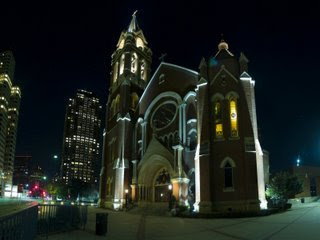
Below is a picture of a former church of ours that is still very dear to my wife and me. Taken 1-1-08.
-RCW


 Posts
Posts

